Reviewing Livin on Prayer: A Designer’s Take
As an embroidery designer who has spent countless hours hooping fabrics and troubleshooting tension issues, I approach every new machine embroidery design with a mix of curiosity and caution. We have all been there: you download a file that looks stunning on the screen, only to find it puckers the fabric or loses its charm once the needle hits the cloth. Today, I am taking a close look at Religious Quote, Livin on Prayer. This piece falls under the category of Print Templates and Graphics, but for us stitchers, the real question is how it translates from a digital concept to a tangible, stitched reality.
First Impressions and Visual Personality
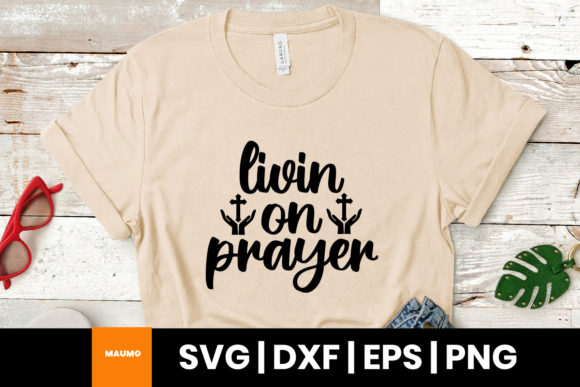
The first thing that strikes me about Religious Quote, Livin on Prayer is its inherent warmth. It does not scream for attention with overly complex flourishes; instead, it relies on a clean, confident layout that speaks to faith and comfort. The mood is inviting, making it an ideal candidate for projects where the message matters as much as the aesthetic. When I visualize this design, I see it working best on items that are meant to be held, worn, or gifted with intention. It feels less like a loud statement piece and more like a gentle reminder, which is a powerful niche in the current market for handmade products.
From a structural perspective, the design appears balanced. For embroidery, balance is crucial. If the weight of the design is too heavy on one side, it can cause hoop burn or distortion, especially on lighter fabrics. While I cannot verify the exact stitch density without opening the file, the visual spacing suggests a thoughtful approach to lettering and spacing. This is vital for readability. In embroidery, tiny details can get lost if the running stitch or satin stitch work is too dense or too sparse. This design seems to prioritize clarity, which is a green flag for any embroidery project intended for commercial sale.
Real-World Application: The Custom Tote Scenario
To truly evaluate Religious Quote, Livin on Prayer, let us walk through a realistic scenario. Imagine a client approaches your craft business asking for a set of reusable tote bags for a church group or a family reunion. They want something durable, meaningful, and stylish. This is where this design shines. A canvas tote bag provides a stable, woven surface that handles embroidery beautifully. The texture of the canvas complements the thread, adding depth to the finished product.
In this context, the design serves as a focal point. Because it is a quote, placement is key. Centered on the front of the bag, it becomes a wearable testimony. As an Etsy seller or small shop owner, you know that customers love personalization. While this specific file is a fixed quote, its style lends itself well to being part of a larger collection. You could pair it with simple floral motifs or crosses to create a cohesive line of design assets. The versatility here is high. It is not just for bags; imagine this on a heavy cotton apron for a baker who values their faith, or on a cushion cover for a living room reading nook. The emotional connection the buyer feels to the phrase "Livin on Prayer" adds perceived value to the item, allowing you to price your small shop product competitively.
Navigating Fabric and Hoop Constraints
However, practical design judgment requires us to look at the limitations. Not every fabric is a friend to every design. If you are planning to use Religious Quote, Livin on Prayer on a stretchy t-shirt or a thin silk blouse, you need to proceed with caution. Textured fabrics and stretchy materials require robust stabilization. Without a proper cut-away stabilizer, the stitching could pull and pucker, ruining the crisp lines of the text. For a sweatshirt embroidery project, the fleece or cotton blend is generally forgiving, but you must ensure the hoop size is large enough to accommodate the full width of the quote without cropping.
Another critical consideration is the scale. If you attempt to shrink this design down for a baby embroidery project, such as a onesie or a small bib, you risk losing legibility. Small lettering requires precise digitizing. If the gaps between letters are too tight, the threads may merge, creating a blob rather than a word. I always recommend stitching out a test on scrap fabric of the same type you intend to use for the final product. This step saves time and materials. Check the thread colors against your fabric. A high-contrast combination, like white thread on navy blue, will make the design pop, while low-contrast choices might look subtle and elegant but could be hard to read from a distance.
Commercial Viability and Brand Consistency
For those of us running a commercial embroidery operation, consistency is king. Using a design like Religious Quote, Livin on Prayer helps build a brand identity centered on faith, family, and comfort. It fits seamlessly into categories like holiday embroidery for Easter or Christmas gifts, or as a year-round personalized gift option. When customers see a well-stitched, clear design, their trust in your craftsmanship increases. This leads to repeat business and positive reviews.
It is important to note the file formats provided. The description mentions an SVG file for Cricut Explore and Silhouette, along with a DXF file. As an embroiderer, you need to be aware that SVG and DXF are primarily vector files used for cutting machines, not necessarily native embroidery machine formats like PES, DST, or JEF. If you are using this for embroidery, you may need to convert these vectors into an embroidery file using digitizing software, or ensure that the provider offers specific machine-compatible formats. If this is intended for heat transfer vinyl (HTV) application rather than direct stitching, the SVG format is perfect. However, if you are looking for a ready-to-stitch digital embroidery file, double-check the package contents. Misunderstanding file types is a common pitfall for new creative entrepreneurs.
Practical Designer Notes for Best Results
- Test Before You Sell: Always stitch a sample on your intended fabric. Check for puckering, thread breaks, and color accuracy.
- Stabilizer Selection: Use a tear-away stabilizer for stable woven fabrics like cotton or canvas. Use a cut-away stabilizer for knits and stretchy materials like t-shirts and sweatshirts.
- Thread Quality: Invest in high-quality polyester or rayon threads. They reduce breakage and provide a sheen that enhances the visual appeal of the applique design or text.
- Hoop Management: Ensure your hoop is tight and the fabric is drum-tight. Loose fabric leads to uneven stitches and misalignment.
- Licensing Check: Confirm the license terms. Can you sell finished items made with this design? Most designers allow commercial use for physical products but restrict the resale of the digital file itself. Respect intellectual property to maintain professionalism in the craft business community.
- Mockup Verification: Create printable mockup images to show customers how the design looks on different products. This helps manage expectations and reduces return requests.
In conclusion, Religious Quote, Livin on Prayer offers a solid foundation for meaningful, marketable goods. Whether you are creating a tote bag design for a local boutique or an embroidered patch for a jacket, the key lies in execution. By paying attention to fabric choice, stabilization, and file compatibility, you can transform this graphic into a cherished custom apparel piece or home decor item. It is a design that respects its message, and with careful handling, it will respect your craftsmanship too.