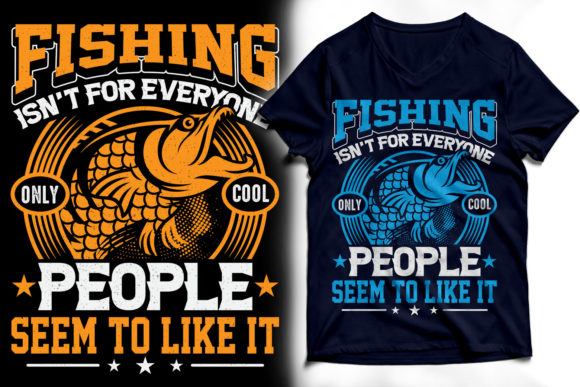
Reviewing Fishing T-shirt Design 3 for Embroidery
As a designer who spends more time staring at stitch maps than actual fabric, I have learned that not every digital embroidery file translates well from screen to needle. When I first opened Fishing T-shirt Design 3, my initial reaction was one of cautious optimism. The preview looked clean, but we all know that a pretty JPEG can hide a multitude of stitching sins. My job here is to look past the marketing gloss and evaluate this asset as a functional tool for real-world production. Whether you are an Etsy seller looking to expand your outdoor-themed catalog or a hobbyist making a personalized gift for a angler in your life, understanding the practical implications of this design is crucial before you hit "start" on your machine.
First Impressions and Visual Personality
The mood of Fishing T-shirt Design 3 is distinctly recreational and relaxed. It does not scream "hardcore tournament pro," but rather evokes the quiet satisfaction of a morning on the lake. This visual personality matters because it dictates where the design belongs. In my experience, designs with this specific thematic weight perform best on casual wear and lifestyle accessories. It feels approachable. The layout appears balanced, avoiding the common pitfall of heavy, lopsided weighting that can cause hoop burn or fabric distortion. For those of us creating design assets for small shops, this balance is vital. A design that looks good in isolation but pulls awkwardly on a curved surface is a liability, not an asset.
When evaluating the detail level, I noticed a moderate complexity that suggests versatility. It is not so intricate that it requires micro-stitching, which often leads to thread breaks on older machines, nor is it so blocky that it lacks character. This middle ground is where many successful T-Shirt Designs live. It allows for clear recognition without demanding perfection from the operator. For a craft business, this means fewer wasted blanks and higher consistency across multiple units.
Real-World Application Scenarios
Let’s move beyond theory and talk about application. I recently worked on a project involving a custom embroidered tote bag for a local fishing lodge. They wanted something that felt authentic but durable. Fishing T-shirt Design 3 would have been an excellent candidate for this. The scale of the graphic suits the broad canvas of a canvas tote perfectly. Because the design likely utilizes a mix of fill stitch areas for solid shapes and satin stitch borders for definition, it holds up well to the textured surface of canvas. The fabric texture of a tote bag can sometimes swallow fine details, but a design with strong silhouettes remains legible.
Another ideal use case is sweatshirt embroidery. Hoodies and crewnecks are staples in the outdoor apparel market. The thickness of fleece or French terry cloth provides a stable foundation for embroidery, allowing the stitches to sit proudly on the surface. However, one must be mindful of the stitch density. If this design has large solid areas, using a lighter weight stabilizer might result in a stiff patch feel. I recommend testing with a cut-away stabilizer for garments that will be washed frequently, ensuring the finished product retains its shape and comfort.
For baby embroidery projects, such as a onesie for a future fisherman, caution is required. While the theme is cute, the size of the design elements must be scaled down appropriately. Tiny details can become scratchy or disappear entirely on small hoops. If you plan to use this for infant wear, ensure you are using soft threads and possibly reducing the density if your software allows, to keep the handmade product gentle against sensitive skin.
Navigating Technical Challenges
No design is universal, and Fishing T-shirt Design 3 is no exception. There are specific scenarios where you should proceed with care. First, consider dark fabric. If the design relies on subtle color gradients or light thread colors, stitching on black or navy blue requires careful planning. You may need an underlay of white thread to prevent the fabric color from showing through, which adds bulk and time. Always check your thread color contrast before committing to the final piece.
Curved surfaces, such as caps, present another challenge. While this design might work as a front-panel embroidered patch, applying it directly to a structured cap requires precise hooping. If the design has wide horizontal spans, it may bridge or gap on the curve of a hat. I advise creating a printable mockup wrapped around a 3D cap model to visualize potential distortion before stitching. Additionally, avoid placing dense stitch areas near seams or pockets, as the needle may deflect, causing misalignment.
Thin or stretchy fabrics are also problematic. A standard t-shirt jersey can pucker easily if the stabilizer is not chosen correctly. For these materials, a lightweight tear-away or a fusible interfacing might be necessary to support the machine embroidery design without adding excessive stiffness. Always test on scrap fabric first. This simple step saves countless hours of frustration and preserves your reputation for quality.
Commercial Value and Brand Consistency
For commercial embroidery professionals, the value of a design lies in its reliability and appeal. Fishing T-shirt Design 3 offers a recognizable theme that resonates with a specific demographic. This specificity helps in targeting customers who are passionate about their hobbies. When used consistently across a product line—such as matching towels, aprons, and shirts—it builds brand recognition. Customers trust a shop that presents cohesive, high-quality Graphics rather than a haphazard collection of unrelated images.
The professionalism of the final stitch-out directly impacts customer trust. A clean, well-digitized design signals attention to detail. Conversely, loose threads, jumps, or uneven coverage can deter repeat business. By carefully reviewing the embroidery file settings and adjusting for your specific machine, you ensure that every item meets a high standard. This diligence transforms a simple digital purchase into a premium personalized gift or boutique item.
Practical Designer Notes
Before you integrate Fishing T-shirt Design 3 into your workflow, keep these practical tips in mind:
- Test on Scrap: Always stitch out a test piece on the same fabric type you intend to use for the final product. This reveals issues with tension, density, and color interaction.
- Check Licensing: The product description mentions buying digital files for yourself, friends, and family. It is critical to confirm whether commercial use is permitted. If you are an Etsy seller or run a small shop product line, you must have explicit rights to sell finished items made with this design. Do not assume; verify.
- Review Stitch Density: High-density areas can cause puckering on thin fabrics. Consider using auto-digitizing software to adjust density if the original file is too heavy for your material.
- Contrast Matters: Ensure your thread choices provide enough contrast against the fabric. A lack of contrast can make the design look muddy or indistinct from a distance.
- Hoop Size Compatibility: Confirm that the design fits within your available hoop sizes. If resizing is necessary, do so proportionally to avoid distorting the aspect ratio.
In conclusion, Fishing T-shirt Design 3 is a promising addition to your library of T-Shirt Designs. It offers a blend of thematic charm and structural simplicity that suits a wide range of embroidery projects. By approaching it with a critical eye and adhering to best practices in stabilization and thread selection, you can create stunning, durable products that delight customers and enhance your portfolio. Remember, the best design is not just the one that looks good on screen, but the one that stitches out reliably and beautifully in the real world.